UCEED admissions, eligibility, fees, seats, exam dates and counselling rules can change every year. This guide explains the process, but always verify the latest official notice before applying, paying fees or making a final decision.
UCEED admission information last checked: Aug 2026
Official UCEED Updates → https://uceed.iitb.ac.in/2026/
How to Score High in Sketching
In UCEED, clarity beats creativity, and thinking beats talent. A step-by-step guide to mastering the 100-mark Part B section.
The Truth About UCEED Part B (No One Tells You)
Most UCEED aspirants believe one thing: “If I draw well, I will score well.” And that’s exactly where they go wrong. As we detail in our UCEED Entrance Exam Guide, Part B is not about making museum-worthy artistic renderings. It is about how clearly you can think and express your ideas visually. Every year, thousands of students practice shading, detailing, and “perfect sketches”… but still lose marks.
Because IITs are not testing your fine art skills—they are testing your design thinking + visual communication. Whether you are aiming for Industrial Design or interaction streams through our Career Discovery Guides, evaluator rubrics focus on: Can you simplify a problem? Can you show perspective correctly? Can you tell a functional story? Mastering our UCEED Part B Drawing Strategy is what actually gets you rank-defining marks.
Why Part B Matters More Than You Think
Part A may help you clear the preliminary cutoffs, but Part B decides your final rank, seat allocation, and IIT campus allotment. Candidates who review the UCEED Seat Acceptance Process and IIT B.Des Counselling & Placements know that every single mark in Part B shifts your rank by hundreds of spots. This is where average students drop and serious aspirants rise. The difference is not talent—it is strategy + understanding.
Reality Check
You don’t need to be an artist to crack IIT design. Before deciding between NID vs NIFT vs UCEED, know that you DO need:
- Clear logical thinking & problem identification
- Strong real-world observation skills
- Basic sketching control & grid proportions
- A structured approach like our 2027 Preparation Roadmap
What You’ll Learn in This Guide
What UCEED Part B actually tests in evaluation
How to practice drawing the right way for IIT B.Des admissions
Step-by-step strategy to improve speed and line control
Common sketching mistakes that reduce precious marks
Real exam approach mapped out in our 2027 Preparation Roadmap
Evaluation rubrics & mark-maximizing scoring techniques
What UCEED Part B Actually Tests
Before you start practicing sketching, you need to understand one thing clearly: UCEED Part B is not testing your drawing talent—it is testing your thinking through drawing. As highlighted in our Part B Drawing Strategy Guide, evaluators look for core problem-solving logic.
Visual Clarity
Can you translate complex thoughts into clean, confident lines that communicate effectively without messy over-rendering or fuzzy hatching?
Design Thinking
Can you solve user problems, redesign everyday objects, and apply practical logic whether designing for product usability or Communication Design visual stories?
Observation
Can you see the physical world, understand structural mechanics, and accurately represent human figures with proportion and perspective?
Final Understanding
UCEED Part B evaluates three core abilities: Visual Clarity, Design Thinking, and Observation.
If your idea is strong but drawing is basic, you can still score high.
If your drawing is beautiful but idea is weak, you will lose marks.
Core Skills You Must Build for UCEED Part B
Now that you understand what UCEED Part B actually tests, the next question is: What exactly should you practice? Most students waste time doing random, unstructured sketching… But UCEED entrance exam preparation requires focused skill-building. Whether you’re following our UCEED 2027 Complete Guide or sharpening specific techniques, here are the 5 core skills you must develop:
Perspective
The foundation of visual spatial rendering. Practice one-point and two-point perspective, horizon eye levels, and depth grid techniques using our structured Part B Drawing Strategy.
Human Figures
Focus on quick gesture drawing, natural movement, dynamic action postures, and proper proportion relative to environments over hyper-detailed anatomical rendering.
Object Sketching
Draw everyday products and analyze how people interact with them. Essential for aspirants aiming for Industrial Design careers through IIT B.Des programs.
Composition
Master visual hierarchy, scene framing, balanced spatial placement, line weight hierarchy, and establishing a clear focal point for evaluation rubrics.
Design Thinking
The ultimate rank differentiator. Identify user pain points in everyday scenarios, apply functional logic, and express user-centric solutions visually with annotations.
Daily Practice System for UCEED Part B (Non-Negotiable)
Cracking UCEED Part B doesn’t require exhausting 5–6 hour drawing marathons. As detailed in our How to Start Preparing for UCEED 2027 Strategy, consistency always beats intensity. You only need a structured 60–90 minutes of focused daily practice to build top-tier visual problem-solving skills.
Warm-Up
Master line control, smooth circles, ellipses, parallel hatching, and basic 3D geometric forms to build muscle memory and confidence.
Perspective
Construct 1-point and 2-point perspective grids, interior room setups, and spatial depth following our Part B Drawing Guide.
Figures & Objects
Practice quick gesture poses, human proportions in action, and real-world product sketching for Design Career discovery scenarios.
Design Thinking
Analyze everyday user problems, sketch innovative product redesigns, and practice functional annotations to maximize evaluator rubric scores.
Stick to this routine 5 days a week, and your visual communication will transform within 30 days.
Common Mistakes That Kill Your UCEED Part B Score
Even well-prepared aspirants lose critical marks in UCEED Part B due to avoidable execution errors. When evaluating thousands of answer sheets, IIT faculties look for structural logic and visual clarity. As outlined in our UCEED 2027 Comprehensive Guide, avoiding these seven common pitfalls can instantly boost your rank:
Real Exam Approach for UCEED Part B (Step-by-Step Strategy)
Many students panic, rush, or misinterpret the prompt—and lose critical marks in UCEED Part B. Executing under exam pressure requires a structured system. Follow this exact step-by-step process during the exam, as recommended in our Part B Drawing Strategy Guide, to maximize your evaluation rubric score:
Read & Deconstruct Carefully
Analyze the prompt thoroughly. Highlight key requirements, required object interactions, mandatory human figures, and the specific perspective angle demanded.
Plan Composition & Layout
Thumbnail quick 30-second layout options in the margin. Establish horizon line eye-level, vanishing points, primary focal point, and visual hierarchy before touching the main sheet.
Light Rough Block-In
Block out major structural forms, background environment, and basic human figure stick poses using light guide strokes. Check relative scale and proportion accuracy early.
Final Line Work & Detailing
Apply confident, dark primary contours. Build clear line weight variation, refine human gestures, texture details, and add cast shadows for spatial depth using techniques from our 2027 Prep Strategy.
Add Design Thinking Callouts
Write short, legible functional annotations, feature callouts, and directional arrows to explain ergonomic mechanisms or product usability clearly to evaluators.
Final Quality Check
Verify every prompt constraint is fulfilled, erase stray construction lines, ensure clean presentation, and confirm your visual story reads effortlessly.
Never skip Step 2 (Planning). Spending just 3–5 minutes planning composition saves you from realizing halfway through that your main subject doesn’t fit on the page!
Ready to Master UCEED Part B?
Knowing the strategy is only the first step—flawless execution is what actually secures your rank. Don’t leave your design career to chance when structured mentorship and real-time visual evaluation are within reach. If you are preparing for the upcoming entrance cycle, start by diving into our comprehensive UCEED 2027: Complete Guide to master the eligibility criteria, updated syllabus, exam pattern, and long-term preparation roadmap.
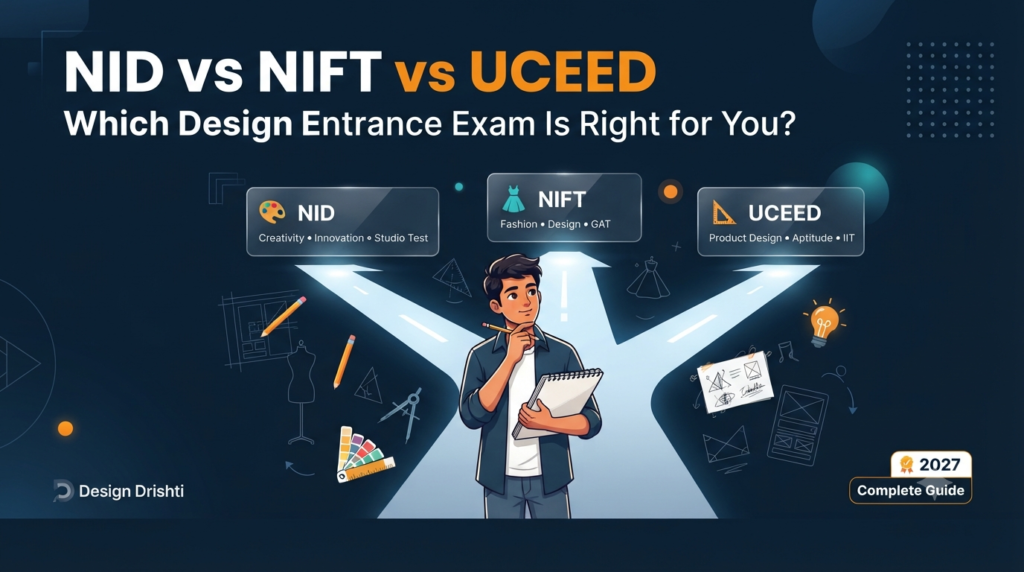
For candidates navigating current admissions and seat allocation, explore our detailed UCEED Counselling & Placements Guide to understand round-by-round seat allotment and career placement outcomes across IIT B.Des campuses. If you are actively participating in counselling, our step-by-step UCEED Round 2 Seat Acceptance Guide walks you through securing your seat without hassle. Still weighing your national exam options? Read our side-by-side analysis of NID vs NIFT vs UCEED to clarify exam differences and choose the right design discipline for your goals.
Ready to take control of your preparation? Connect with our mentors to accelerate your progress and get direct visual feedback on your sketches: