
The GAT Series · Book 3 of 4
Non-Verbal Reasoning for NID, NIFT & UCEED
Seventeen figure-based reasoning formats, from Series to Shape Construction, taught with clear diagrams and simple visual rules. Train the spatial thinking that design entrance exams test in their visual reasoning questions.
About This Book
What Non-Verbal Reasoning Means for Design Exams
Non-verbal reasoning uses figures instead of words: mirror images, paper folding, cube faces, patterns and shapes. It tests how well you can see, rotate and combine forms in your head, which is exactly the kind of thinking design courses build on. UCEED and CEED test visual and spatial reasoning in Part A, and NIFT’s General Ability Test can include figure-based reasoning. NID has included such questions in past papers, though its most recent Prelims did not have a GAT section.
figure-based formats, from Series to Shape Construction
diagram questions with step-by-step visual solutions
heavy reading needed — every question is a visual puzzle
Chapter by Chapter
All 17 Chapters and Where They Matter
Each chapter opens with its target exams, so you know where to spend your time first.
“Standard category” means the format is a recognised non-verbal reasoning question type; question types and frequency vary by exam and year. NID levels reflect earlier papers: the most recent NID DAT Prelims did not include a GAT section, and NID can change its pattern in any year. Always check the latest official exam notice.
Inside Every Chapter
Learn, Then Practise, Then Test Yourself
Concept Walkthrough
Visual rules explained simply, with fully worked diagram examples.
Solved Questions
Step-by-step visual solutions with a speed tip for each.
Practice + Answer Key
Forty figure questions to test yourself, with answers at the end of the chapter.
Try It Yourself
One Example, One Question for You
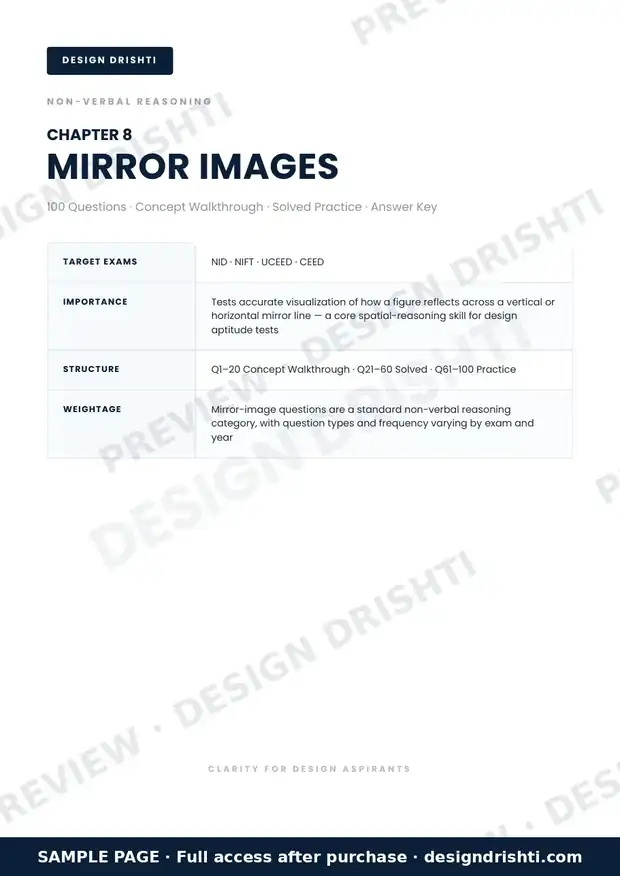
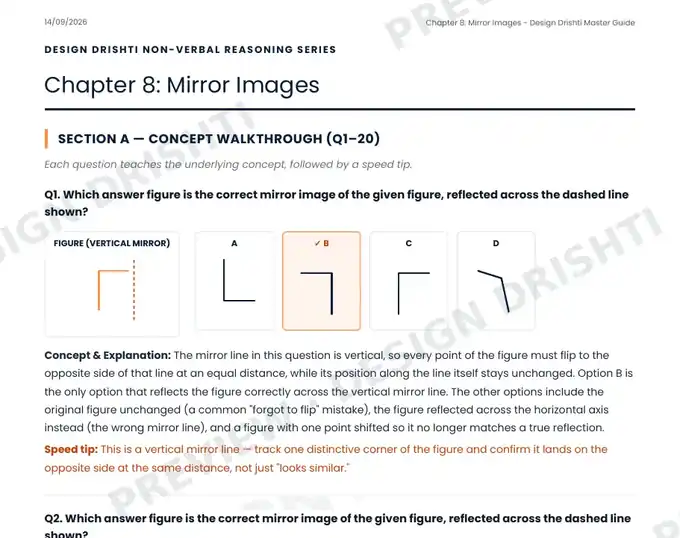
Both questions follow the Chapter 8 (Mirror Images) format. Study the example, then try the next one.
Which figure is the correct mirror image of the given figure in the vertical mirror line M?
Solution: A vertical mirror flips left and right, but top and bottom stay where they are. The foot of the L moves from the right side to the left side, while staying at the bottom. That is option C.
Tip: Track one corner — in a vertical mirror it only changes sides, never height.
Which figure is the correct mirror image of the given flag in the vertical mirror line M?
🎉 Correct! You have a great eye for symmetry.
The pole moves to the right and the flag now points left, but it stays at the top. This book has 1,700 visual questions like this.
Get the Full BookNot quite. Here’s the trick.
In a vertical mirror, left and right swap but top stays top. So the pole moves right and the flag points left, still at the top: option D. Chapter 8 trains this with 20 worked examples.
Learn It ProperlyPricing
Buy This Book, or Save With the Full Set
This Book Only
Non-Verbal Reasoning
- 17 chapters, 1,700 questions
- Online view-only access till your exam
All 5 Books
Complete Study Material Set
- This book plus Quantitative Aptitude, Analytical Reasoning and English Communication
- Design & Drawing Module with Practice Workbook
- Just ₹400 per book, versus ₹599 for one
Non-Verbal Reasoning Book
₹599
Pay via UPI AppButton works on phones. On a laptop, scan the QR.
🔒 Your UPI app may show our payment partner’s name as the payee.
After paying, submit your details
Choose “Single book: Non-Verbal Reasoning – ₹599” in the form. Access is usually sent within 1–2 hours. Refunds are available only before access is sent.
Plan Your Preparation
Guides That Go With This Book
Always confirm exam patterns on the official websites: NIFT · NID Admissions · UCEED · CEED
FAQs
Questions About This Book
Do I need to be good at drawing for this book?
No. Non-verbal reasoning is about seeing and comparing figures, not drawing them. Every answer is chosen from options.
Which exams is this book most useful for?
UCEED and CEED, whose Part A tests visual and spatial reasoning, and NIFT, whose GAT can include figure-based reasoning. NID has tested these formats in past papers, but its most recent Prelims had no GAT section.
How is this different from Analytical Reasoning?
Analytical Reasoning covers word, number and logic-based questions. This book covers figure-based questions such as mirror images, paper folding and cubes.
Can I download or print the book?
No. Access is online and view-only, linked to your registered email, and stays valid until your exam.