What is Industrial Design?
Industrial Design is the practice of designing mass-produced physical products — everything from furniture and kitchen appliances to cars, medical devices, and consumer electronics. An Industrial Designer decides how a product looks, how it feels in your hand, and how easily you can use it, before it ever goes into a factory.
According to the World Design Organization (WDO), Industrial Design is a strategic problem-solving process that drives innovation, builds business success, and leads to a better quality of life through innovative products, systems, services, and experiences. It sits at the intersection of three fundamental pillars: form (how it looks), function (how it works), and manufacturability (how it can actually be built at scale, affordably). A good Industrial Designer isn’t just sketching pretty objects — they’re solving a practical human problem within real constraints of materials, cost, and production.
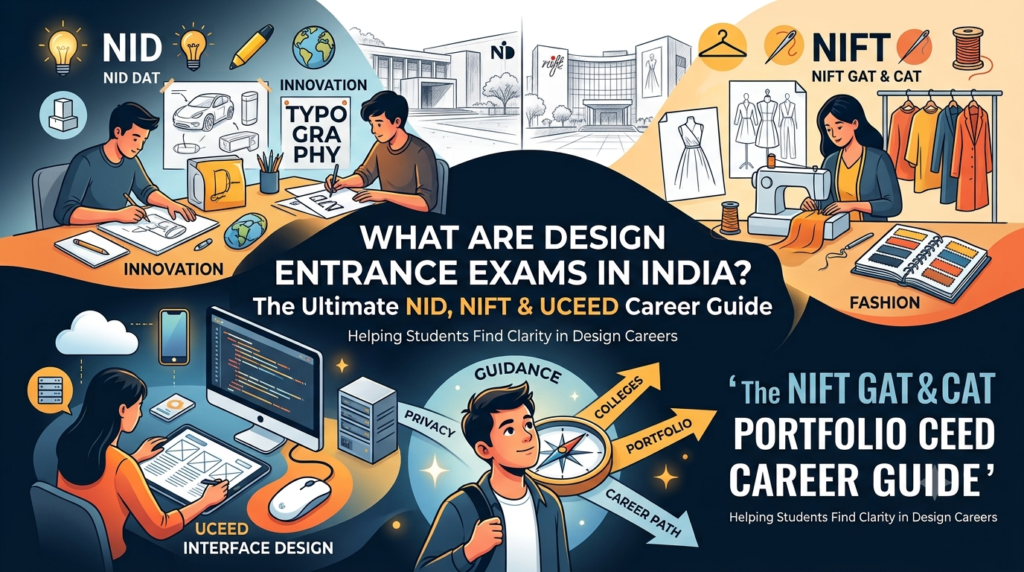
This is distinctly different from fields like Communication Design (visual/graphic media) or Fashion Design. Industrial Design is specifically about three-dimensional, physical, mass-manufactured products. If you enjoy sketching objects, understanding how things are made, and thinking about everyday usability, this field is built around exactly that. If you’re still exploring overall entrance options, start with our guide on What Are Design Entrance Exams in India.
Why This Domain Exists & Why It Matters in India Right Now
Every mass-produced object you use went through an Industrial Design process before it reached you. Someone had to decide its shape, its material, where the buttons go, how it feels when you pick it up — and how it can be manufactured a million times over without costs spiraling out of control.
Without Industrial Design, products would be built purely around engineering convenience or manufacturing ease — functional, but often clunky, uncomfortable, or confusing to use. The field exists to put the human user at the center of decision-making, without losing sight of what’s actually possible to build and sell at scale. To understand how design compares to traditional professional paths, read our analysis on Is Design a Good Career in India?.
Why it matters more in India right now
As Indian manufacturing grows (electronics, EVs, consumer appliances) and D2C startups multiply, companies increasingly need designers who understand both user experience and Indian manufacturing realities — not just imported design sensibilities. That’s created real, growing demand for this skill set domestically, not just abroad.
Sub-Disciplines Within Industrial Design
Industrial Design isn’t one single job — it branches into specializations based on the type of product you focus on. Most designers pick a lean after a few years of general practice, though a B.Des degree covers the fundamentals of all of them:
Product Design
Consumer electronics, appliances, everyday objects — the broadest and most in-demand specialization across hardware startups and tech companies.
Furniture Design
Chairs, tables, storage systems — balancing ergonomics, structural stability, material selection, and manufacturing cost at scale.
Mobility & Vehicle Design
Two-wheelers, EVs, public transport, automotive interiors — one of the fastest-growing areas given India’s massive EV transition push.
Toy & Game Design
Designing for play, physical child safety, cognitive engagement, and durability — a niche but steadily growing domestic market.
Ceramic & Glass Design
Tableware, home decor, architectural elements, and functional glass/ceramic objects — a craft-adjacent, specialized domain.
Career Snapshot: A Day in the Life
Most people picture Industrial Design as sitting around sketching all day. In reality, sketching is a small fraction of the job — most of your time goes into research, iteration, and coordinating with people outside the design team.
🛠️ What the work actually involves
• User research: Observing how people actually interact with a product in real life, not how you assume they use it.
• 3D Modeling & CAD: Translating rough sketches into digital models using tools like SolidWorks, Rhino, or Fusion 360.
• Prototyping: Building physical foam models, 3D prints, or working mockups to test ergonomics and function before manufacturing.
• Engineering collaboration: Working closely with mechanical engineers to ensure materials, tolerances, and wall thicknesses are viable.
• Client & Stakeholder pitches: Presenting concepts to product managers and defending design decisions with logic, user data, and business constraints.
Job Roles & Career Progression
Titles vary between companies, but the general career trajectory in Industrial Design follows this structure:
| Stage | Typical Title | What You’re Doing |
|---|---|---|
| 0–2 years | Junior / Associate Industrial Designer | Executing under direction — user research, concept sketches, CAD models, prototype iterations. |
| 2–5 years | Industrial Designer | Owning smaller projects end-to-end, presenting directly to engineering teams, clients, or PMs. |
| 5–8 years | Senior Industrial Designer | Leading design direction on major product lines, mentoring juniors, defining studio quality standards. |
| 8+ years | Design Lead / Head of Design | Setting design strategy, managing cross-functional teams, driving product vision and leadership. |
Some designers also transition laterally into UX/UI design, physical product strategy, design research, or launch their own product studios after 5–7 years of core Industrial Design experience.
Companies Hiring Industrial Designers
The hiring landscape spans manufacturing giants, consumer product companies, D2C startups, and design consultancies — not just specialized design studios:
India-Based / India Offices
• Godrej & Boyce
• TVS Motor Company
• Titan Company
• Samsung R&D India
• Whirlpool India
• Design Consultancies (Onio, Kinnect, Idiom)
Global Roles & Consultancies
• IDEO
• Frog Design
• Philips Design
• Dyson
• Herman Miller
• Consumer Tech R&D Centers
Salary Expectations in India
Figures below represent standard industry ranges across top product companies and design consultancies in India:
| Experience Stage | Approximate Annual Salary (LPA) |
|---|---|
| Entry-Level (0–2 yrs) | ₹4 – ₹7 LPA |
| Mid-Level (3–5 yrs) | ₹8 – ₹14 LPA |
| Senior-Level (6–9 yrs) | ₹15 – ₹25 LPA |
| Design Lead / Head (10+ yrs) | ₹25+ LPA |
For Parents — Career Financial Trajectory
Starting salaries for design freshers from top institutes like NID or IITs are comparable to solid engineering packages. More importantly, industrial design compensation scales rapidly as a designer builds a proven portfolio of mass-produced products and masters advanced 3D CAD and manufacturing knowledge.
Scope: India vs Abroad
In India
• Growing fast due to “Make in India” initiatives and rising D2C consumer hardware brands.
• More generalist roles — designers often wear multiple hats early in their career.
• Strong emerging opportunities in EV/mobility, consumer electronics, and medical hardware.
• Lower starting pay than Western markets, but significantly lower cost of living.
Abroad
• Mature, highly specialized roles at established global design consultancies.
• Higher financial packages, but accompanied by higher living costs and visa requirements.
• Breaking in generally requires an exceptional global portfolio and often a specialized Master’s degree.
• Extremely competitive global talent pool.
Who Thrives Here — and Who Struggles
You’ll Likely Thrive If You:
• Enjoy solving practical everyday problems, not just making artistic objects.
• Love understanding how things are engineered, assembled, and manufactured.
• Can handle constructive jury critiques and feedback without taking it personally.
• Are comfortable working within real-world constraints (budget, material limits, deadlines).
You Might Struggle If You:
• Demand total creative freedom with zero commercial or manufacturing constraints.
• Dislike team critiques or having your design choices challenged by engineers.
• Are seeking a purely “fine-arts” career detached from business realities.
• Have zero interest in technical tools, software, or manufacturing processes.
Top Colleges for Industrial Design in India
Government institutes generally offer high brand value, lower fees, and deep industry recognition. Elite private colleges offer alternative admission pathways and modern infrastructure.
| College / Institute | Program Offered | Primary Entrance Exam |
|---|---|---|
| NID Ahmedabad / Gandhinagar / Bengaluru | B.Des Industrial Design | NID DAT |
| IIT Bombay (IDC School of Design) | B.Des | UCEED |
| IIT Guwahati (Dept. of Design) | B.Des | UCEED |
| IIITDM Jabalpur | B.Des | UCEED |
| MIT Institute of Design, Pune | B.Des Product Design | MIT-ID DAT / UCEED Accepted |
| Symbiosis Institute of Design (SID), Pune | B.Des Product Design | SEED (Symbiosis Entrance) |
To evaluate exam pathways for government design institutes, read our comprehensive breakdown on NID vs NIFT vs UCEED. If you are building a backup strategy, check our guide to Best Private Design Colleges in India (Plan B Strategy).
Common Myths About Industrial Design
Myth 1: “Industrial Design is just sketching cool products all day.”
Truth: Sketching is only 15-20% of the actual job. Most of your time goes into user research, 3D CAD modeling, material testing, prototyping, and coordinating with engineers.
Myth 2: “You need to be a naturally gifted fine artist to get in.”
Truth: Entrance exams test observation, spatial logic, and creative problem-solving far more than fine-art drawing skill. Industrial sketching is a learnable, structured communication tool.
Myth 3: “Industrial Design and Architecture are basically the same thing.”
Truth: They deal with entirely different scales, manufacturing tools, regulatory approvals, and career realities. Read our detailed comparison on Design vs Architecture: Which is Better?.
Alumni Insights: What Graduates Actually Say
“Nobody tells you how much of the first year at NID is just unlearning how you were taught to draw in school. It’s less about talent, more about retraining how you observe physical objects.”
“The studio culture is intense — critique sessions can feel brutal at first. You either learn to separate your ego from your work fast, or you struggle the whole degree.”
“I did Mechanical Engineering at IIT, then cleared UCEED/CEED for design. If you’re technically strong but want creative control over what you build, this crossover works incredibly well.”
Frequently Asked Questions (FAQs)
Do I need to know how to draw well to get into Industrial Design?
No. Entrance exams like NID DAT and UCEED test spatial aptitude, observation, logic, and perspective understanding far more than artistic drawing. Industrial sketching is a technical communication tool that can be completely learned with structured practice.
What’s the difference between Industrial Design and Product Design?
In traditional terms, Product Design is a core sub-field of Industrial Design focusing on physical consumer products. However, in modern tech terminology, “Product Design” often loosely refers to digital software (UI/UX), while “Industrial Design” strictly refers to physical 3D products.
Can I get into Industrial Design through 12th Science or Engineering?
Yes, absolutely! Students from Science, Commerce, or Arts streams can pursue B.Des in Industrial Design through NID DAT or UCEED. Science and engineering backgrounds are actually a strong advantage due to the technical nature of manufacturing and CAD software.
Is NID or IIT (UCEED) better for Industrial Design?
Both are premier institutes. NID offers a deeper pure-design culture and artistic experimentation, while IITs (IDC Bombay, Guwahati, IIITDM) excel at integrating technology, engineering logic, and hardware innovation into product design.
What is the typical starting salary for Industrial Designers in India?
Fresh graduates from tier-1 institutes (NID, IITs) typically start around ₹5 LPA to ₹9 LPA, depending on whether they join hardware startups, manufacturing firms, or MNC tech R&D centers.
Explore the Complete Design Drishti Hub
Ready to begin your preparation journey? Read our master roadmap: How to Start Preparing for NID, NIFT & UCEED 2027.
Targeting National Institutes of Design? Explore the comprehensive guide: NID Entrance Exam Complete Authority Guide.
Aiming for IIT Design programs? Master the gateway: UCEED Entrance Exam Guide: Decode the IIT Design Pathway and check our UCEED 2027 Complete Guide.
Comparing other design domains? Read our companion guide: Communication Design: Career Scope, Courses & Complete Guide.
Deciding between B.Des and B.Arch? Study the full reality check: Architecture Admission Guide 2026: NATA vs JEE Paper 2.
New to Design Drishti? Start from the core: Start Here — The Design Drishti Guidance Hub.