What is Fashion Design?
Fashion Design is the art and technical science of applying design, aesthetics, garment construction, and natural beauty to clothing and lifestyle accessories. It is influenced by cultural attitudes, social trends, material innovations, and commercial market demands.
Modern fashion extends far beyond basic apparel design. Today, fashion professionals drive luxury brands, sustainable fashion systems, 3D digital sampling, retail management, fashion communication, costume design, and smart wearable technology. Whether your ambition is to launch an independent label, work with national retail brands, or lead creative direction for global fashion houses, the field demands a blend of visual creativity, technical precision, and market awareness.
If you are evaluating creative streams after Class 12, explore our overview on What Are Design Entrance Exams in India? or compare this discipline with Communication Design and Industrial Design.
Why Fashion Design Matters Today
Fashion influences personal identity, cultural preservation, and global commerce. The textile and apparel industry represents one of the largest economic sectors in India, driving manufacturing, export trade, retail, and digital e-commerce growth.
Today’s fashion designers do not simply draw sketches; they solve ergonomic, functional, and environmental challenges. With rising global awareness around circular manufacturing, designers are expected to understand eco-friendly fibers, zero-waste pattern making, and ethical supply chains. To understand how design careers stack up against traditional professions, read our detailed analysis on Is Design a Good Career in India?.
For Parents: Industry Shift in India
Fashion in India has evolved from unorganized tailoring into a massive, organized multi-billion dollar retail ecosystem. Major Indian conglomerates like Aditya Birla Fashion, Reliance Retail, and Tata Trent actively recruit fresh design graduates alongside global fast-fashion and luxury brands.
Essential Skills Every Fashion Designer Should Develop
Building a successful career requires combining artistic expression with practical technical knowledge. Key skill areas include:
🎨 Creative Thinking
Developing original concepts, visual storytelling, color theory, and trend forecasting for competitive commercial markets.
✏️ Sketching & Technical Drawing
Communicating garment construction ideas clearly using fashion illustrations, croquis, and precise flat working specs.
🧵 Material & Textile Knowledge
Understanding fibers, weave structures, surface ornamentation, drape, pattern drafting, and garment manufacturing methods.
💻 Digital Software Proficiency
Mastering industry software including Adobe Illustrator, Photoshop, CLO 3D, and specialized fashion CAD tools.
📊 Market & Commercial Awareness
Analyzing consumer behavior, retail price structures, merchandise planning, and global fashion supply chains.
🤝 Communication & Teamwork
Collaborating effectively with pattern makers, sampling tailors, merchandisers, photographers, and manufacturing suppliers.
Specialisations Within the Fashion Ecosystem
Fashion design branches into diverse specializations depending on your interest in technical crafting, visual media, or business management:
Core Apparel & Garment Design
Womenswear, Menswear, Kidswear, Couture, Pret-a-Porter, Activewear, Knitwear, and Garment Construction Technology.
Textile & Surface Ornamentation
Woven textiles, print design, embroidery techniques, dyeing technology, and sustainable fiber development.
Fashion Communication & Styling
Visual merchandising, fashion journalism, celebrity styling, art direction, fashion photography, and digital brand storytelling.
Accessories & Leather Design
Footwear design, handbag crafting, leather goods, jewelry design, and luxury lifestyle accessories.
Retail, Merchandising & Business
Fashion buying, retail store operations, luxury brand management, e-commerce, and fashion entrepreneurship.
Digital Fashion & Tech Innovation
3D virtual garment modeling, smart textiles, wearable tech, AI design workflows, and circular fashion systems.
Fashion Design Entrance Exams in India
Securing admission to premier fashion institutes requires targeted preparation for design aptitude tests, creative skills, and studio evaluations:
| Exam | Conducting Body / Colleges | Selection Process |
|---|---|---|
| NIFT Entrance Exam | National Institute of Fashion Technology (18 Campuses) | CAT (Creative Ability Test) + GAT (General Ability Test) + Situation Test / Interview |
| NID DAT | National Institute of Design (Ahmedabad, Gandhinagar, etc.) | DAT Prelims (Objective & Drawing) + DAT Mains (Studio Test & Interview) |
| UCEED | IIT Bombay (IDC, IIT Guwahati, IIT Hyderabad, IIITDM Jabalpur) | Part A (Computer-based Aptitude) + Part B (Drawing & Design Skills) |
| Private University DATs | Pearl Academy, UID Karnavati, MIT-ID Pune, World University of Design | Design Aptitude Test + Portfolio Evaluation + Personal Interview |
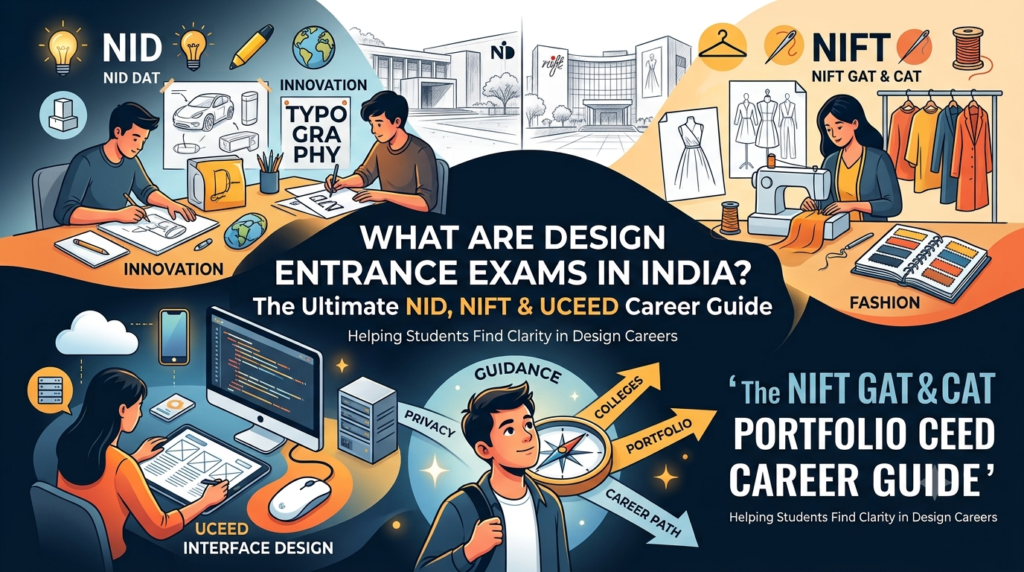
For a side-by-side comparison of national entrance tests, read our breakdown on NID vs NIFT vs UCEED. If you are preparing specifically for NIFT, review the NIFT Syllabus Guide and our strategy on NIFT Situation Test Preparation.
A Day in the Life of a Fashion Designer
🛠️ Realistic Work Breakdown
• Trend Research & Moodboards: Analyzing upcoming seasonal color palettes, runway forecasts, and consumer preferences.
• Concept Sketching & Draping: Translating ideas into flat technical sketches and draping fabric test samples on dress forms.
• Fabric Sourcing & Testing: Visiting textile mills or trade markets to select weight, weave, and trim specifications.
• Pattern Making & Fitting: Collaborating with master tailors to fit early prototypes on fit models and correcting silhouette lines.
• Tech Pack Creation: Documenting measurements, stitch types, colorways, and trim details for mass factory production.
Popular Career Roles in Fashion Design
Design Roles
• Fashion Designer
• Apparel Designer
• Textile Designer
• Accessory Designer
• Costume Designer for Film/OTT
Creative Roles
• Fashion Stylist
• Visual Merchandiser
• Fashion Illustrator
• Art Director
• Fashion Journalist
Business Roles
• Fashion Buyer
• Merchandiser
• Luxury Brand Manager
• Category Manager
• Boutique Owner
Tech & Future Roles
• 3D Digital Garment Designer
• Sustainable Fashion Consultant
• Wearable Tech Designer
• Smart Textile Specialist
Where Do Fashion Designers Work?
Employment spans national retail chains, export houses, luxury couture houses, e-commerce giants, and creative consultancies:
National Retail & Export Majors
• Aditya Birla Fashion (Madura, Pantaloons)
• Reliance Retail (AJIO, Trends, Marks & Spencer India)
• Raymond Group
• Arvind Limited
• FabIndia & Manyavar
• Shahi Exports & Gokaldas Exports
Global Brands & Creative Houses
• Zara (Inditex) & H&M
• Uniqlo India
• Decathlon
• Couture Design Studios (Sabyasachi, Manish Malhotra, Anita Dongre)
• Film & OTT Media Production Houses
• Fashion Tech & E-commerce Startups
Salary Expectations in India
| Career Stage | Experience Level | Approximate Salary Range (LPA) |
|---|---|---|
| Entry-Level / Fresher | 0–2 Years | ₹3.5 – ₹6.5 LPA |
| Mid-Level Designer | 3–6 Years | ₹7 – ₹12 LPA |
| Senior Designer / Manager | 7–10 Years | ₹14 – ₹22 LPA |
| Design Director / Head of Category | 10+ Years | ₹25+ LPA |
Note on Earning Ceiling
Salaries vary significantly based on portfolio quality, software proficiency (3D CAD tools), and institute reputation. Independent fashion label founders, celebrity stylists, and senior luxury brand heads can achieve significantly higher earnings outside standard corporate brackets.
Scope: Working in India vs Opportunities Abroad
Career Scope in India
• Booming D2C e-commerce ecosystem creating demand for young apparel designers.
• Massive heritage textile industry offering opportunities in artisan & modern craft fusion.
• Rapid expansion of organized retail chains into tier-2 and tier-3 Indian cities.
• Expanding entertainment industry (Bollywood, regional cinema, OTT) requiring costume design.
Global Opportunities
• International fashion capitals (Paris, Milan, London, New York) value strong technical pattern-making and sustainable design skills.
• Higher starting pay packages, balanced by higher living expenses and visa regulations.
• Indian designers are increasingly sought after by global brands for heritage embroidery and textile innovation expertise.
Who Thrives vs Who Struggles in Fashion Design
You Will Likely Thrive If You:
• Enjoy observing cultural trends, street style, textiles, and human behavior.
• Possess strong spatial awareness and love working with tactile materials.
• Balance artistic imagination with commercial practicality and deadline discipline.
• Accept constructive design critiques and iterate rapidly based on feedback.
You May Struggle If You:
• View fashion purely as glamour, ignoring technical garment drafting and factory work.
• Dislike learning software applications like Adobe Suite or 3D CLO tools.
• Expect success without investing consistent time in pattern-making and stitching labs.
• Resist commercial market feedback or client preferences.
Top Fashion Design Colleges in India
| College / Institute | Programs Offered | Primary Entrance Exam |
|---|---|---|
| NIFT (Delhi, Mumbai, Bengaluru, Chennai, Kolkata, etc.) | B.Des Fashion / Textile / Accessory / FC / B.F.Tech | NIFT Entrance Exam |
| NID (Ahmedabad, Gandhinagar) | B.Des Apparel Design / Textile Design | NID DAT |
| Pearl Academy (Delhi, Mumbai, Jaipur) | B.Des Fashion Design / Fashion Communication | PAF Entrance Exam / DAT |
| Unitedworld Institute of Design (UID), Karnavati | B.Des Fashion Design & Styling | UID DAT |
| MIT Institute of Design, Pune | B.Des Fashion Design | MIT-ID DAT |
| Srishti Manipal Institute, Bengaluru | B.Des Textiles & Apparel Operations | SMEAT |
Building your institutional backup list? Read our strategic overview on Best Private Design Colleges in India: Plan B Strategy.
Common Myths About Fashion Design
Myth 1: “You must be an amazing fine artist to study Fashion Design.”
Fact: Entrance exams test observation, proportion, and creative problem-solving rather than realistic fine art portraiture. Technical sketching is taught systematically during the degree.
Myth 2: “Fashion Design is only about designing runway dresses.”
Fact: High-fashion couture represents less than 5% of the overall industry. Over 95% of fashion designers work in retail pret-a-porter, sportswear, activewear, textiles, styling, and corporate brand management.
Myth 3: “Fashion Design offers limited career stability.”
Fact: Organized fashion retail conglomerates, export houses, and e-commerce platforms offer structured corporate career paths, performance bonuses, and long-term security equal to other creative industries.
Alumni Insights: What Graduates Actually Say
“Your first year at NIFT will force you out of your comfort zone. You spend long hours in garment construction labs learning how a 2D fabric sheet transforms into a structured 3D garment.”
“Software skills like CLO 3D and Photoshop give freshers a massive advantage during industry internships. Companies want designers who can render realistic 3D samples instantly.”
Frequently Asked Questions (FAQs)
Can Commerce or Science students pursue Fashion Design after 12th?
Yes. Students from any academic stream (Arts, Commerce, or Science) in Class 12 are eligible to apply for B.Des in Fashion Design at NIFT, NID, and major design universities across India.
What is the difference between B.Des Fashion Design and B.F.Tech?
B.Des Fashion Design focuses on creative apparel design, aesthetics, styling, and conceptual development. B.F.Tech (Bachelor of Fashion Technology) at NIFT is an engineering-adjacent program focused on apparel production technology, factory management, and garment manufacturing logic (requires Class 12 Science with Physics, Chemistry & Math).
How important is a portfolio for Fashion Design admissions?
For premier government colleges like NIFT and NID, initial selection relies on CAT/GAT written exam scores followed by Situation Tests or Studio Tests. For major private institutes and international universities, a well-structured portfolio showcasing concept development, sketching, and material exploration is essential.
Is NIFT or NID better for Fashion Design?
NIFT is specialized specifically for the fashion, textile, accessory, and apparel industry with specialized faculty and direct retail campus placements. NID offers a broader interdisciplinary design perspective with deep focus on design thinking, material research, and conceptual innovation.
Explore More Design Drishti Guides
Kickstart your overall prep strategy: How to Start Preparing for NID, NIFT & UCEED 2027.
Planning your NIFT journey? Read the master guide: NIFT Complete Authority Guide for Students & Parents and master the NIFT Counselling Preference Strategy Guide.
Targeting NID? Check out the NID DAT Syllabus Breakdown & Prep Plan and NID DAT PYQ Analysis.
Exploring alternative creative disciplines? Read our complete guides on Communication Design Career Scope and Design vs Architecture: Which is Better?.
New to our platform? Start your journey here: Start Here — The Design Drishti Guidance Hub or explore all fields in our Career Discovery Category.