/* Header: keep menu on one line and button horizontal on small laptops/tablets (922-1240px) */ #masthead .ast-header-button-1 .ast-custom-button{white-space:nowrap} @media (min-width:922px) and (max-width:1240px){#masthead .main-header-menu>.menu-item>.menu-link{padding-left:8px!important;padding-right:8px!important;font-size:12.5px!important}#masthead .ast-header-button-1 .ast-custom-button{padding:10px 14px!important;font-size:13px!important}}

The GAT Series · Book 1 of 4

Quantitative Aptitude for NID, NIFT & UCEED

Every quant topic design entrance exams draw on, from Numbers to Logarithms, taught in simple language and practised chapter by chapter until it becomes second nature.

28 Chapters2,800 Questions785 PagesAccess till your exam
The GAT Series · Book 1Quantitative AptitudeDesign Drishti

About This Book

What Quantitative Aptitude Means for Design Exams

Design entrance exams are not maths exams, but several of them test basic numerical reasoning. NIFT’s General Ability Test gives quant the most room, and UCEED/CEED test it more lightly inside reasoning and numerical-answer questions. NID has included GAT-style questions in past papers, though its most recent Prelims paper did not have a GAT section, so treat NID quant as useful backup rather than a priority. This book covers everything at school level, so you can score these marks quickly and spend your time on the creative sections.

8 of 28

chapters rated High importance for NIFT

9 of 28

chapters rated Medium for NID, based on past papers

5 of 28

chapters rated Medium importance for UCEED / CEED

Chapter by Chapter

All 28 Chapters and Where They Matter

Each chapter opens with its target exams and an estimated importance for each one, so you know where to spend your time first.

HighMedium-HighMediumLow-MediumLowRarely tested
#Chapter & what it coversNIFTNID (past papers)UCEED / CEED
01
NumbersFoundational — divisibility, factors, unit digits and remainders feed into almost every later chapter.
NIFTHigh
NIDMedium
UCEED/CEEDLow-Medium
02
HCF and LCMDecides whether a question wants the biggest common piece or the smallest common whole — one word in the question tells you which.
NIFTMedium-High
NIDLow-Medium
UCEED/CEEDLow
03
AverageOne habit answers almost every question: turn every average into a total before doing anything else.
NIFTMedium-High
NIDLow-Medium
UCEED/CEEDLow
04
PercentageThe base of Profit and Loss, Interest and Data Interpretation — weak percentages slow down four later chapters.
NIFTHigh
NIDMedium
UCEED/CEEDLow-Medium
05
Profit, Loss and DiscountEverything turns on knowing which base a percentage is taken on — cost price for profit, marked price for discount.
NIFTHigh
NIDMedium
UCEED/CEEDLow-Medium
06
Ratio & ProportionUnderpins Mixtures, Time & Work, Time-Speed-Distance and Partnership later in the book.
NIFTHigh
NIDMedium
UCEED/CEEDLow-Medium
07
PartnershipAn application of the ratio skills from Chapter 6, mostly relevant to NIFT and NID.
NIFTMedium
NIDLow
UCEED/CEEDRarely tested
08
Simple InterestA direct extension of Percentage — a small, predictable set of formulas.
NIFTMedium
NIDLow-Medium
UCEED/CEEDLow
09
SimplificationA calculation-speed skill every quant section relies on — BODMAS errors are among the most common avoidable mistakes.
NIFTHigh
NIDMedium
UCEED/CEEDMedium
10
Time and WorkBuilds on inverse proportion from Chapter 6 and sets up Pipes & Cisterns.
NIFTHigh
NIDMedium
UCEED/CEEDLow-Medium
11
Pipes and CisternTime & Work with pipes as workers — the only new idea is that a draining pipe subtracts from the rate.
NIFTMedium
NIDLow-Medium
UCEED/CEEDLow
12
Time and DistanceThe foundation for Races, Trains, and Boats & Streams.
NIFTHigh
NIDMedium
UCEED/CEEDLow-Medium
13
Boats and StreamsRelative speed from Time & Distance — the current either helps or hinders the boat.
NIFTMedium
NIDLow-Medium
UCEED/CEEDLow
14
Races and Games of SkillHead starts and beat-by margins are simply disguised speed ratios.
NIFTLow-Medium
NIDLow
UCEED/CEEDRarely tested
15
Problems on TrainsTime & Distance with one twist: the train has length, so crossing means covering that length too.
NIFTMedium-High
NIDLow-Medium
UCEED/CEEDLow
16
Problems on NumbersPure equation-forming: the arithmetic is easy, the marks are lost in translating words into equations.
NIFTMedium
NIDLow-Medium
UCEED/CEEDLow
17
Allegation or MixtureOne rule (the allegation see-saw) replaces a page of algebra once it is set up in the right direction.
NIFTMedium-High
NIDLow-Medium
UCEED/CEEDLow
18
Problems on AgesAn easy-scoring topic once you apply the years to the actual ages, not to the ratio.
NIFTMedium
NIDLow-Medium
UCEED/CEEDLow
19
Chain RuleThe engine behind Work, Pipes and Speed questions — direct or inverse proportion, decided correctly.
NIFTMedium-High
NIDLow-Medium
UCEED/CEEDLow
20
ClocksA visual-reasoning topic where one relative-speed idea answers almost every question.
NIFTMedium
NIDLow-Medium
UCEED/CEEDLow
21
CalendarEntirely rule-based — once odd-day counts are memorised, these become some of the fastest questions to solve.
NIFTMedium
NIDLow
UCEED/CEEDLow
22
AreaThe most design-relevant quant chapter — the same reasoning behind layouts, floor plans and material estimates.
NIFTHigh
NIDMedium
UCEED/CEEDMedium
23
Volume and Surface Area3D spatial thinking — every formula is a 2D area either stacked or wrapped.
NIFTMedium-High
NIDMedium
UCEED/CEEDMedium
24
Height and DistanceOnly three angles appear — 30°, 45° and 60° — so the chapter rests on a handful of values.
NIFTMedium
NIDLow-Medium
UCEED/CEEDLow
25
Permutations and CombinationsThe counting foundation that the Probability chapter is built on.
NIFTMedium-High
NIDLow-Medium
UCEED/CEEDMedium
26
ProbabilityEvery answer is favourable outcomes over total outcomes, counted using the previous chapter.
NIFTMedium-High
NIDLow-Medium
UCEED/CEEDMedium
27
Compound InterestThe growth formula behind population, depreciation and inflation questions.
NIFTMedium-High
NIDLow-Medium
UCEED/CEEDLow
28
LogarithmsShort and entirely rule-based — among the quickest topics to master once the definition clicks.
NIFTMedium
NIDLow
UCEED/CEEDLow

Importance levels are estimates based on past paper patterns and vary from year to year. NID levels reflect earlier papers: the most recent NID DAT Prelims did not include a GAT section, and NID can change its pattern in any year. Always check the latest official exam notice.

Inside Every Chapter

Learn, Then Practise, Then Test Yourself

Q1–20

Concept Walkthrough

Formulas and rules explained simply, with fully worked examples.

Q21–60

Solved Questions

Step-by-step solutions with a “solve under 1 minute” tip for each.

Q61–100

Practice + Answer Key

Forty questions to test yourself, with answers at the end of the chapter.
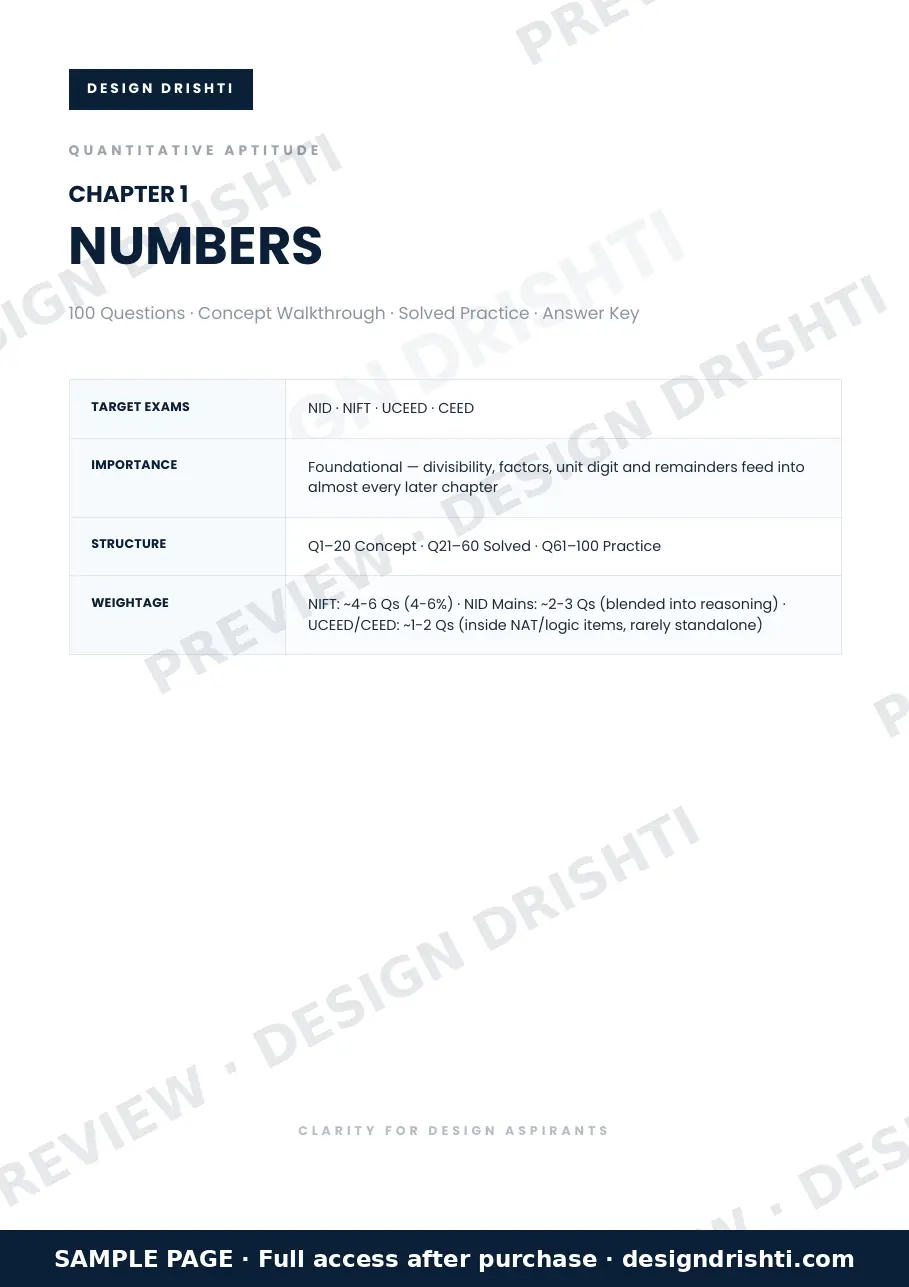
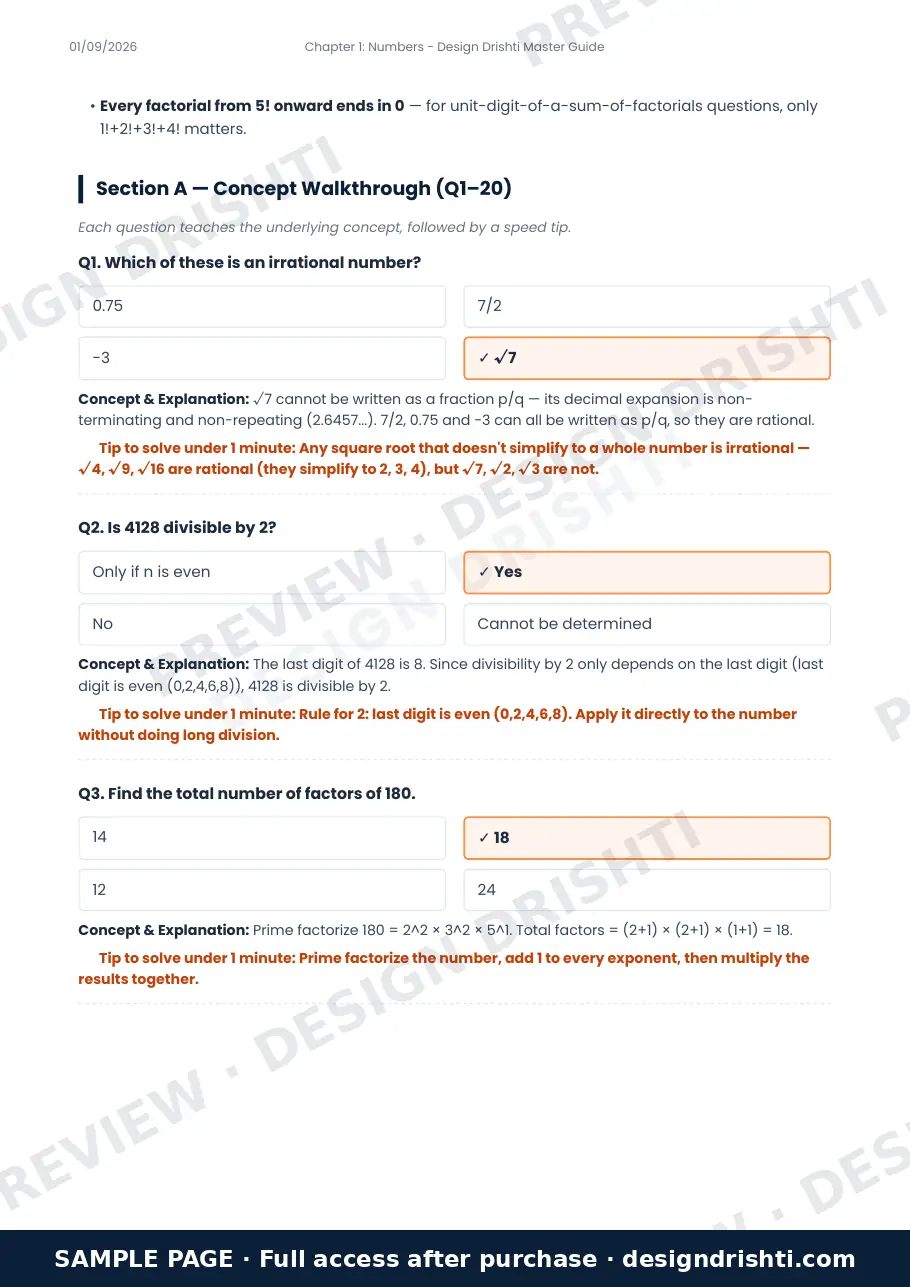
Quantitative Aptitude Chapter 1 cover showing target exams and weightageSample concept walkthrough page from the Quantitative Aptitude book

Try It Yourself

One Example, One Question for You

Both questions are taken from Chapter 1 (Numbers). Study the example, then try the next one.

Solved Example

Find the total number of factors of 180.

A. 14
B. 18 ✓
C. 12
D. 24

Solution: 180 = 2² × 3² × 5¹. Add 1 to each power and multiply: (2+1) × (2+1) × (1+1) = 18.

Tip: Prime factorise, add 1 to every exponent, then multiply.

Your Turn

Find the total number of factors of 360.

🎉 Correct! You’re thinking like a topper.

360 = 2³ × 3² × 5¹, so the factors are (3+1) × (2+1) × (1+1) = 24. This book has 2,800 more questions like this.

Get the Full Book

Not quite. Here’s the trick.

360 = 2³ × 3² × 5¹. Add 1 to each power: (3+1) × (2+1) × (1+1) = 24. Chapter 1 teaches this step by step with 20 worked examples.

Learn It Properly

Pricing

Buy This Book, or Save With the Full Set

This Book Only

Quantitative Aptitude

₹599
  • 28 chapters, 2,800 questions
  • Online view-only access till your exam
Better Value

All 5 Books

Complete Study Material Set

₹2,000₹3,295
  • This book plus Analytical Reasoning, Non-Verbal Reasoning and English Communication
  • Design & Drawing Module with Practice Workbook
  • Just ₹400 per book, versus ₹599 for one
See the Full Set

Quantitative Aptitude Book

₹599

Pay via UPI App

Button works on phones. On a laptop, scan the QR.

🔒 Your UPI app may show our payment partner’s name as the payee.

After paying, submit your details

Choose “Single book: Quantitative Aptitude – ₹599” in the form. Access is usually sent within 1–2 hours. Refunds are available only before access is sent.

Plan Your Preparation

Guides That Go With This Book

Always confirm exam patterns on the official websites: NIFT · NID Admissions · UCEED · CEED

FAQs

Questions About This Book

Do I need to be good at maths to use this book?

No. Every chapter starts from the basics with worked examples, and the level stays at school maths. It is written for design aspirants, not engineering aspirants.

Which exam is this book most useful for?

NIFT, where quant has the largest share of the General Ability Test. It also covers the numerical reasoning tested in UCEED/CEED. NID has tested these topics in past papers, but its most recent Prelims had no GAT section, so check the latest NID notice before prioritising quant for NID.

Can I download or print the book?

No. Access is online and view-only, linked to your registered email, and stays valid until your exam.

Should I buy this book alone or the full set?

If you are preparing for more than one section of the GAT, the full set of 5 books at ₹2,000 works out to ₹400 per book and also includes the Drawing module.

Scroll to Top