Is Architecture The Right Choice For You?
Before committing to 5 years of intense studio work, evaluate whether your mindset aligns with what the architectural discipline demands:
Creative Thinkers
Students who enjoy observing spaces, structures, and visual ideas rather than just drawing pretty pictures.
Strategic Problem Solvers
Architecture is the art of solving functional human problems. You need to enjoy logic as much as art.
Resilient Learners
You are comfortable with criticism, revisions, and the “long-haul” intensity of a 5-year studio degree.
For Parents
Architecture is a “prestige” degree, but it is not a traditional engineering path. It requires a significant financial and emotional investment. Please read this guide with your child to understand the 5-year commitment before settling for any random college.
⚠️ Architecture Looks Beautiful From The Outside
In reality, it is one of the most mentally demanding creative degrees. Every year, thousands of students choose architecture based on cinematic reels and luxury campus videos, only to face severe burnout due to studio pressure, endless software learning, and the harsh reality of jury critiques. Do not choose this path for the “glamour”—choose it because you are ready to survive the 5-year grind.
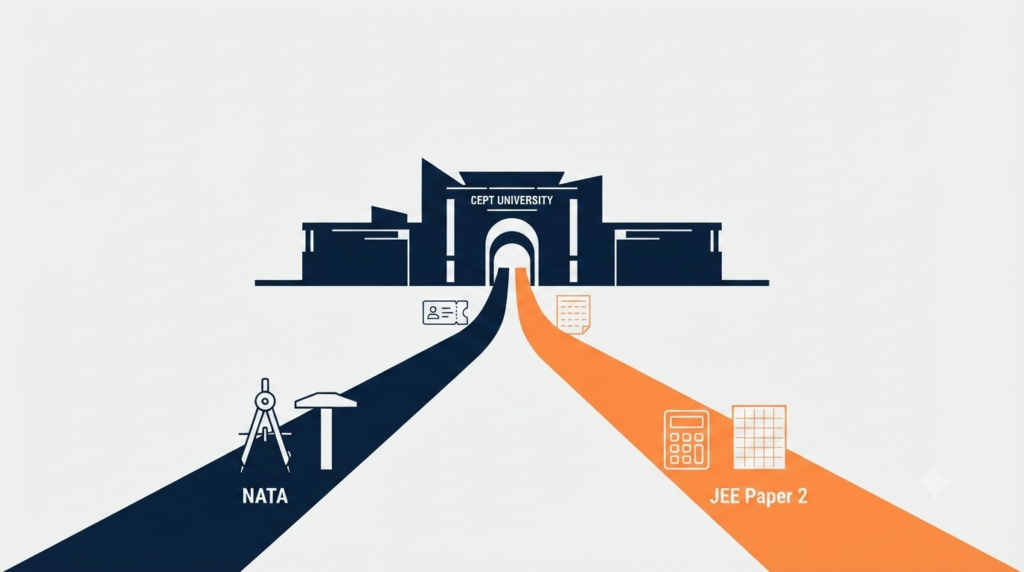
NATA vs JEE Paper 2 — Which Architecture Exam Is Better?
Understanding how these two gateway exams differ is essential for planning your preparation timeline and targeting the right colleges:
| Factor | NATA | JEE Paper 2 |
|---|---|---|
| Difficulty Level | Moderate to Conceptual | Highly Competitive |
| Drawing Weightage | Very Important | Reduced Pattern |
| Aptitude Focus | Visualization + Creativity | PCM + Aptitude + Speed |
| Govt Colleges | CEPT, State Govt Institutions | IITs, NITs, SPAs |
| Attempts | Multiple Attempts | Limited Attempts |
| Competition | Broader Aspirant Pool | Extremely High Engineering Competition |
🎓 Mentor Note
The smartest architecture aspirants prepare for BOTH NATA and JEE Paper 2 together. Do not rely on one exam emotionally; use them as strategic tools to open access to both private and elite government institutions.
Government vs Private Architecture Colleges: The Real Difference
| Factor | Government Colleges | Private Colleges |
|---|---|---|
| Fees | Much lower tuition fees | Can be expensive |
| Exposure | Strong academic culture | Depends heavily on ecosystem |
| Peer Group | High competitive filtering | Varies significantly |
| Brand Value | Higher historical credibility | Strong only in select elite cases |
| ROI | Usually stronger return on investment | Depends strictly on studio quality |
🎓 Mentor Note
Architecture is a portfolio-driven profession. College reputation helps initially, but your long-term growth is determined by your software skills, internships, and portfolio quality, not just the college tag.
The Biggest Mistake Students Make
⚠️ Avoid the “Aesthetic” Trap
Many students select colleges based solely on Instagram reels, campus aesthetics, or luxury infrastructure videos without checking actual academic culture, internship exposure, or faculty quality. This emotional selection often leads to choosing expensive private colleges that offer poor industry ROI, essentially becoming a ₹20 Lakh mistake.
For Parents
Before finalizing a private institution, look beyond the brochure. Ask about their placement records, industry connections, and the studio culture. A beautiful campus does not guarantee a successful career in architecture.
How To Actually Choose The Right Architecture College
Evaluate colleges against these 8 critical practical pillars before filling your preference forms:
01 — Faculty Quality
Architecture education relies on mentorship. Look for colleges with faculty who challenge your design thinking and critique ability.
02 — Jury Culture
A strong college develops a healthy critique culture with external jurors, which improves your communication and presentation skills.
03 — Internship Exposure
Connections to strong firms and urban ecosystems are vital for networking and practical career experience.
04 — City Advantage
Metro cities offer greater exposure to construction sites, exhibitions, and professional networking compared to isolated regions.
05 — Software & Digital Culture
Ensure the college integrates modern tools like Revit, Rhino, Lumion, and BIM into their curriculum.
06 — Alumni Network
A strong alumni ecosystem provides referrals, mentorship, and industry access that can fast-track your career.
07 — Practical Exposure
Prioritize institutes that emphasize site visits, hands-on workshops, and live project involvement.
08 — Studio Culture
Collaborative learning and active peer discussions influence your growth more deeply than modern building aesthetics.
The Financial Reality: Architecture Investment vs. Returns
Plan your finances realistically by accounting for recurring material and software costs alongside tuition fees:
| Expense Item | Approximate Cost |
|---|---|
| College Fees | ₹80,000 – ₹6 Lakhs yearly |
| Laptop (High Graphics) | ₹60,000 – ₹1.5 Lakhs (One-time) |
| Software Subscriptions | ₹10,000 – ₹50,000 yearly |
| Model Making / Materials | ₹15,000 – ₹80,000 yearly |
| Printing & Sheets | ₹5,000 – ₹30,000 yearly |
| Hostel / PG Living | ₹70,000 – ₹3 Lakhs yearly |
| Daily Living & Local Travel | ₹3,000 – ₹15,000 monthly |
Career Stage & Industry Salary Averages
| Career Stage | Average Salary Reality |
|---|---|
| Internship Phase | ₹5,000 – ₹20,000 / month |
| Freshers (0–2 Years) | ₹2 – ₹5 LPA |
| Mid-Level Architects | ₹6 – ₹12 LPA |
| Experienced Professionals | ₹15 – ₹30+ LPA |
For Parents
Many students underestimate the “hidden” costs like model-making materials and software licenses. Architecture is a long-term investment; do not expect instant high salaries upon graduation. Success depends heavily on continuous skill development and portfolio quality over time.
“Unfiltered” Reality of Architecture
Sleepless Nights
Architecture students often endure sleepless nights and extreme deadline pressure during jury and model-making phases.
Jury Pressure
Unlike other degrees, your work is openly critiqued by faculty and external jurors in front of your peers.
The Portfolio Race
In this field, your portfolio often matters more than your marks, requiring constant effort in rendering and visualization.
Internship Reality
Many students encounter low-paid or even unpaid internships, which can be a shock compared to the glamour seen online.
Still Think Architecture Is Right For You?
Architecture is not for everyone. But for the right person who values creative freedom and spatial design, it is one of the most fulfilling careers imaginable.
Before You Choose Architecture
Should YOU Choose Architecture?
Architecture is a fit if you enjoy creative problem-solving, spatial imagination, and can handle long-term project pressure patiently. It is not a fit if you are choosing it primarily for “aesthetic” reasons or a low-pressure college experience.
The Exam Strategy
Maximize your opportunities by preparing for both NATA and JEE Paper 2 simultaneously rather than relying on one. Use the exam phase to widen your pool of college options before making a final selection.
For Parents — Drop Year Decisions
If your child’s score is far below potential, a drop year might be considered—but only if there is a clear, strategic plan to address past mistakes. Otherwise, focus on building skills and portfolio quality in a decent college, which often leads to faster professional growth than an emotional wait for a “top” brand name.
Continue Your Architecture Learning Journey
Before finalizing your exam strategy, understand the full entrance ecosystem with our detailed guide to Architecture Entrance Exams 2026.
If you are ready to apply for NATA, follow step-by-step instructions in our NATA 2026 Application Form & Registration Guide.
To understand how counseling and seat allocation unfold post-results, study the complete blueprint in our JEE Paper 2 & NATA Admission Process Guide.
Still deciding between premier design and architecture hubs? Explore our dedicated CEPT B.Arch Admission Guide for deep insights on portfolio requirements and campus culture.