NIFT Situation Test 2026: Complete Guide for B.Des Students
Everything you need to know about the NIFT Situation Test—from exam format and evaluation criteria to preparation strategy, common mistakes, and what actually helps improve your final B.Des rank.
Who Is This Guide For?
If you’re new to NIFT admissions, begin with our NIFT 2026 Complete Authority Guide to understand the complete admission process, eligibility, syllabus and counselling.Then compare the final admission rounds in our NIFT Situation Test vs NID Round 2 Guide.After reading this article, continue with our NIFT Counselling & Preference Strategy and finally explore How to Start Preparing for NID, NIFT & UCEED if you’re just beginning your design entrance journey.
What Is the NIFT Situation Test?
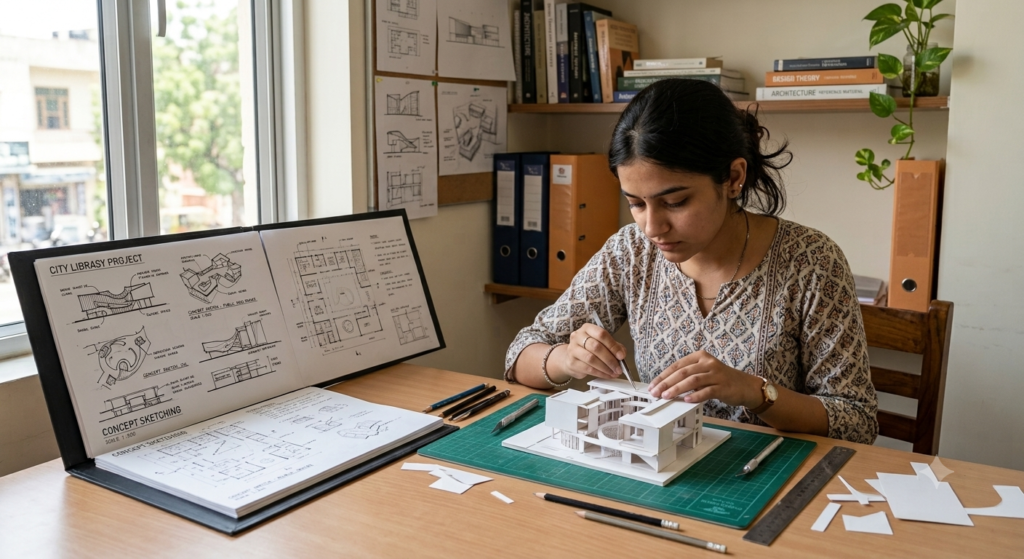
The NIFT Situation Test is the final practical stage of the B.Des admission process. Candidates shortlisted after CAT and GAT are invited to designated NIFT campuses, where they must create a three-dimensional model using the materials provided at the examination centre. Along with the model, every candidate submits a compulsory Concept Note explaining the design idea and execution. Both components are evaluated together and contribute 20% of the final merit score. If you’re unfamiliar with the complete admission process, first read our NIFT 2026 Complete Authority Guide.
01 — Who Appears
Only B.Des candidates shortlisted after the CAT and GAT results receive a Situation Test call letter. B.FTech applicants do not appear for this stage.
02 — Duration
The examination lasts 2 hours. Within this limited time, you must plan, build, finish your model and write a complete Concept Note.
03 — What You Build
Candidates create a three-dimensional model based on the given theme using only the materials supplied inside the examination hall. Personal materials are not permitted.
04 — Concept Note
A concise written explanation describing your concept, design decisions and material usage. An incomplete or unclear Concept Note directly affects your evaluation.
05 — Final Weightage
The Situation Test contributes 20% to your final B.Des merit score. Final merit is calculated using CAT (50%) + GAT (30%) + Situation Test (20%).
Many students underestimate the Situation Test because it contributes “only” 20%. In reality, final merit lists are often decided by very small score differences. A well-executed model with a clear Concept Note can significantly improve your final campus or discipline allocation. Treat this stage with the same seriousness as your CAT and GAT preparation.
What Are You Evaluated On?
Every Situation Test submission is assessed across five key parameters. A creative idea alone isn’t enough—your model, Concept Note, craftsmanship and execution are evaluated together. Understanding these criteria helps you prepare strategically instead of guessing what the examiner wants.
Creativity
Evaluators reward original thinking and meaningful concepts. Safe, copied or predictable ideas usually receive lower scores.
Craftsmanship
Precision, neatness, stability and the quality of construction are closely examined throughout your model.
Material Usage
Smart use of the provided materials demonstrates planning and design thinking. Avoid unnecessary wastage.
Concept Clarity
Your Concept Note should clearly communicate your idea so the evaluator understands your thinking immediately.
Finishing
Clean edges, proper joins and a complete presentation create a strong final impression and improve your score.
The Situation Test is not an art competition. Examiners assess how logically and creatively students solve a problem using limited materials. Encourage calm planning, clean execution and clear explanation rather than last-minute perfection.
What Happens on Exam Day?
Walking into the Situation Test is much less stressful when you know exactly what to expect. Here’s the complete flow—from entering the exam centre to submitting your final model and Concept Note.
Reporting & Verification
Arrive at your allotted NIFT campus with your admit card and a valid photo ID. Verification is completed before entering the examination hall.
Seating & Setup
Candidates are assigned individual workstations. Personal materials are not allowed inside the examination room.
Materials Distribution
Every student receives the same raw materials at the same time, ensuring equal conditions for all candidates.
Theme Announcement
The exam brief or theme is announced. Your two-hour timer starts from this point onward.
Model Making
Build your 3D model using only the supplied materials. Focus on clean construction and effective time management.
Concept Note Submission
Before time ends, submit your completed model along with a clear, written Concept Note explaining your design idea.
The biggest mistake is spending almost the entire two hours building the model and then rushing the Concept Note in the final few minutes. Examiners evaluate both together. During practice, always build your model and write the Concept Note in the same timed session.
How to Prepare for the Situation Test
Most students spend months preparing for CAT and GAT but almost ignore the Situation Test. That’s a costly mistake. Model making is a practical skill, and practical skills improve only through consistent practice. Follow this roadmap instead.
Practice Model Making
Use newspaper, cardboard, wire, cloth and everyday materials regularly. Focus on structure, balance and stability—not decoration.
Use Different Materials
Don’t practice with the same material every time. Adaptability is one of the qualities evaluators appreciate.
Practice With a Timer
Always simulate the real exam with a strict 2-hour limit. Speed and composure improve only under timed practice.
Write the Concept Note
Every practice model should end with a short Concept Note. Learn to explain your idea clearly in just a few lines.
Study Previous Themes
Review previous Situation Test topics like sustainability, urban living, traditional crafts and nature to build familiarity.
Seek Feedback
Show your practice work to a mentor or teacher. Outside feedback reveals mistakes you often can’t identify yourself.
Students who practise model making consistently outperform those who attempt it only once or twice before the exam.
Begin practising at least 3–4 weeks before the Situation Test. Even 20–30 minutes of focused practice, four times a week, develops far better skills than a single marathon session the night before.
Common Mistakes Students Make
Every year, well-prepared students lose marks in the Situation Test—not because they lack creativity, but because of small avoidable mistakes. Here’s what to avoid and what to do instead.
A vague Concept Note loses marks even with a great model.
Reserve the last 25–30 minutes exclusively for writing your Concept Note.
Students often finish the model but rush the explanation.
Aim for roughly 90 minutes for the model and 30 minutes for writing.
Big ideas that remain unfinished score lower than simple, complete solutions.
Choose a practical concept that you can execute neatly within 2 hours.
Using materials without planning limits your later options.
Visualize the model first. Cut only after deciding your complete structure.
Predictable ideas rarely impress the evaluators.
Present an original concept while keeping execution practical.
Visible glue marks, rough edges and untidy presentation reduce craftsmanship marks.
Leave the final few minutes for cleaning, alignment and presentation.
The highest-scoring Situation Test models are rarely the most complicated. They are usually the ones that communicate a strong idea, use materials intelligently, and are completed neatly within the available time.
Two Students. Same Shortlist. Different Results.
Both students cleared CAT and GAT with similar scores. Both received the same Situation Test call letter. What happened during the next four weeks decided everything.
Student A — Prepared
Practiced 3D model making weekly for four weeks.
90 minutes for the model and 30 minutes for the Concept Note.
Clear explanation directly connected to the design brief.
Simple, neat and fully completed.
Moved up in rank through better creativity, craftsmanship and presentation.
Student B — Unprepared
Did not practice after CAT & GAT.
Spent almost all the time on the model and rushed the Concept Note.
Vague explanation with little connection to the brief.
Ambitious but unfinished with rough presentation.
Dropped in rank despite strong CAT + GAT scores.
For Parents
The difference between these two students wasn’t talent. Both had already cleared CAT and GAT. The difference was four weeks of structured practice. If your child has received a Situation Test call letter, the most valuable support you can provide is consistent practice time—not last-minute motivation.
Mentor Note
Confidence isn’t built on exam day—it is built through repetition. Students who practise consistently walk into the Situation Test calm, make better decisions under pressure, and communicate their ideas more clearly.
Get Your Free NIFT Situation Test Checklist
A practical step-by-step checklist covering exactly what to practise, how to manage your 2-hour exam, common mistakes to avoid, and what NIFT evaluators actually expect from shortlisted students.
Download Free ChecklistNeed Personal Guidance?
Every student’s preparation level is different. If you’d like personalised feedback on your Situation Test preparation, portfolio, or career planning, we’re happy to help.
Frequently Asked Questions
Recommended Reading Order
Begin with the NIFT Complete Authority Guide to understand the complete admission process. Next, review the NIFT Syllabus 2027 for section-wise preparation. Continue with the NIFT Counselling Strategy Guide to understand campus preference and seat allotment. Candidates appearing for both examinations should also read the NIFT Situation Test vs NID Round 2 comparison. For additional admission opportunities, refer to the Best Private Design Colleges in India guide.